A pension is a tax-efficient way of saving money for your retirement; they are a long-term investment. They are tax-efficient because, unlike some other types of savings’ plans, they benefit from tax relief. To encourage you to save the government adds money through tax relief.
The benefits that you receive from your pension plan depends on a number of different factors including how much you have in your plan when you decide to take your benefits. You need to remember though that the value of your plan can go down as well as up, depending upon how it has been invested.
Having a pension is a good way to build up a pot of money that you can live off when you retire, when you may not want or be able to work.
What types of pension are there?
The basics of a pension are fairly consistent across all different types of pensions.
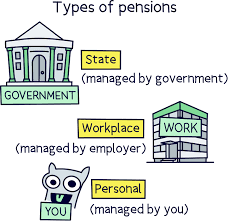
There are three main types of pension - personal pensions, workplace pensions and the State Pension
Workplace pension

The most common type of pension is the workplace pension, where both you and your employer save (or contribute) into a pension. You don't need to open a workplace pension, your employer will do this on your behalf.
This type of pension falls under two categories - defined contribution and defined benefit.
Defined contribution - this is where both you and your employer contribute towards your future.
Defined benefit - this is where your employer promises to pay you a set income when you retire. This comes in two forms, final salary and career average. The amount you receive is worked out in the following way.
Final salary - this is based on how long you've been a member of the scheme and how much you are earning when you stop working.
Career average - this is based on how long you've been a member and the average of the salary you earned over the period of Membership.
Personal Pension
This is a type of pension that you set up yourself. They are quite useful if a workplace pension isn't an option, for example if you're self-employed or if you want to add to your workplace pension savings.
It is a long-term investment that gives your money time to grow. It can give you control over where your money is invested. You could invest in ethical or sustainable funds if that is important to you.
You can continue to invest in a personal pension until you are ready to decide how you use your savings.
You can pay money regularly into a pension as well as making single contributions at any time. This money is invested, with many of them offering a lot of different options you can choose so you need to choose one that’s right for you and your circumstances. If your circumstances change you can also change where your money is invested.
When you are choosing where to invest it's also important to consider how much risk you are comfortable taking. Generally, a higher risk investment will help your money to grow more than a lower risk investment will do, though at the same time there is a higher chance of losing money. At all times it is Important to understand that the value of all investments, both higher risk and lower, can go down as well as up and that you could get back less than you paid in.
You could get a 25% top up on what you save and may be able to claim more from the HMRC if you're a higher rate taxpayer
State Pension
This pension is provided by the government, and you'll normally receive it when you reach state Pension age is currently 66 but for anyone born on or after 6th April 1960 the age requirement is rising in stages to 67. A further gradual rise to 68 is legislated to take place between 2044 and 2046.
How much State Pension you get depends on how much National Insurance contributions you have made when you are working or how many National Insurance credits you have received. You can get National Insurance credits for several qualifying situations:
Unemployment - if you are actively seeking work and claiming benefits
Illness or disability - if you are unable to work through illness or disability and claiming benefits Parents and guardians - if you claim child benefit for a child under the age of 12
Grandparents and family carers - grandparents or family members who look after a child under 12 whose parents work.
Carers - if you are an approved foster carer, kinship carer or look after someone else for 20 hrs a week or more.
Parental leave - if you are on Statutory Maternity, Paternity, Adoption, or Shared Parental Pay Armed forces - if you are the spouse or civil partner of a member of HM Forces accompanying them on overseas posting.
You can choose to defer receiving the state Pension to a later date.
How much can you save?
There is no limit to how much you can save, if you want to you can save up to 100% of your UK earnings into your pension fund each tax year. You will receive tax relief on all regular and single contributions you make to your plan up to a maximum of £3,600 or 100% of your wages, whichever is the greater. Though you can pay in as much as you want there is an upper limit that you can pay in without paying a tax charge. This is known as the annual allowance. The Annual Allowance is normally £60,000 in the current tax year. It can be higher (if you have some leftover from previous years to carry forward) or lower (if you are a higher earner).. Annual Allowances are very complex and if you think this may affect you it is advisable for you to seek professional advice.
From the age of 55 (rising to 57 from April 2028) you can access your pension. this doesn't apply to your state Pension as you won't be able to access this til the minimum age of 66, this can vary depending upon your date of birth. Your workplace pension may also be tied into this retirement age.
When you take your benefits from your pension you can normally take a quarter of it, 25% as a tax-free lump sum. You can take more than this but anything over 25% will be taxed as income.
If you are in receipt of state benefits and you start to take an income or lump sum from these pension benefits it may affect these benefits.
